
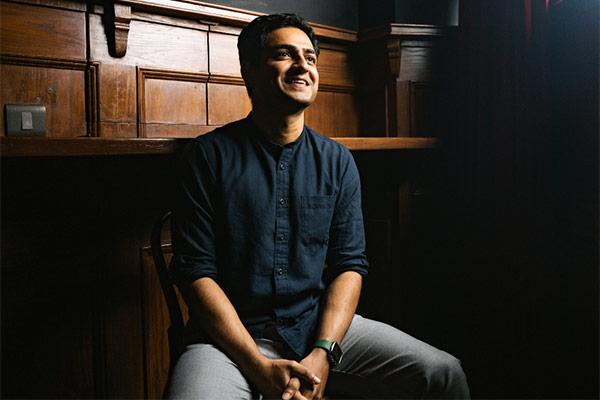
He's been seen on Amazon Prime, YouTube, Comedy Central and Netflix – now, comedian Kenny Sebastian is hitting Australian shores.
The Bangalore-bred, Mumbai-based stand-up is in the midst of one of the largest world tours by an Indian comedian. He's already performed six stand-up specials and has truly created a niche for himself in the industry.
Kenny has played more than 1,500 shows across the world, and his shows are only getting bigger.
Kenny is pouring his heart out in his new show 'Professor Of Tomfoolery', breaking down elements of family and leaving his audiences in stitches. We chat to Kenny in the midst of his Australian dates.
You're heading our way for the 'Professor Of Tomfoolery' tour. It kicked off in May. What has been the highlight so far?
So we have never done such a huge tour in this scale ever. We did India, we did about 80 shows in India and then we came to America and then we came to Europe, in the UK. So it was an incredibly large tour and we've, I think sold around almost 35,000 tickets. So it's been massive. But the highlight for me is every time I think a show in the international market is amazing, the next one is even better because it's so nice to see other Indians enjoying and appreciating you when you're not on home soil. And so it's so endearing and everybody's just so happy to be there. It didn't feel like I was so many miles away from home. So for me, I was just surprised. A lot of the cities in Europe are my first time doing a show, and I was just like, how is the show going to go? And the moment the show starts, I'm just like, oh my god. It's like I'm home. But yeah, I think if you really ask me a big highlight, it has to be my San Jose show, where around 3,000 people at San Jose Civic. And it was surreal for me.
What is it like for you to go on a world tour, especially now that we've moved past all things pandemic?
I never thought in my life that I would have to take people sitting next to each other for granted. So when the pandemic happened, I couldn't believe it was something that can be taken away. So, just the ability for people to sit together and laugh felt like a privilege. And now that's back. So we were like, not only are we going to do India, we're going to do a world tour of this. So it feels great. And I think it just gave us a newfound appreciation for something we kind of didn't realise we took for granted, you know, the ability for people to sit together and enjoy something.
Your first recorded stand-up special was in 2014, but you rose to prominence in the late 2000s. What is the most important lesson you've learned about the art of comedy so far in your career?
I'm still learning it. It's a fine balance between doing what the audience wants and doing what you want. And unlike most other forms of art that are in the entertainment zone, it's a very tough thing to find. Sometimes the universe works in your favour, where your style and your ideas kind of sync up with what the world is feeling. And when that happens, everybody loves your work and finds it relevant. And then somewhere down the line, when you try to chase relevancy, your work suffers. And somewhere down the line you chase authenticity, just being true to yourself. And then the audience kind of pulls back. So I constantly remind myself that this is like a moving, organic thing and to never relax and assume that I know what works and what doesn't work, and stand-up fortunately and unfortunately doesn't let you relax, you know? Your audience will let you know pretty quickly that, yeah, we don't like it. So it's one of the good and bad things about stand-up that you need such constant feedback from the audience. It's one of the few art forms where you need a reaction every few seconds, and that reaction is involuntary. It's laughter. So there's a slim chance you're not doing something right with stand-up because the audience kind of stops connecting with you. And another thing I do make sure is when I'm writing my material for the new show, I don't always perform in front of my fans and my audience. I perform it in front of a generic comedy-going audience who have a wide like and dislike, and preference to comedy. That way, I know that if the joke is working with people who don't follow my work, then it should work pretty well with people who follow my work. So, yeah, the art of comedy has taught me that you can't relax with stand-up. It always keeps you on the edge and ready.
In terms of comedy icons, who is somebody you look up to the most?
My first exposure to stand-up was Jerry Seinfeld, and now I follow Bill Burr and Dave Chappelle and John Mulaney. In terms of the international comics, I'm very lucky that my colleagues in India are some of the biggest comedians. So I really like looking over to what Biswa is doing. What Kanan is doing. These are two comics from Bangalore as well. They're also my very close friends. So I look up to my friends with their work and I look up to these legends to kind of guide me on writing work that I'm constantly proud of.
Was there a moment early in your life where you felt particularly compelled to jump on board the comedy train?
There was no comedy train when I started back in 2011, 2012, in India it wasn't a profession. It was definitely a thing abroad. It was not a thing here. And I definitely didn't think you could make money out of it. So I'm kind of glad I got into stand-up comedy when there was no incentive monetarily. The incentive was very pure. The incentive was, oh my god, there's a space where you can go and just do stand-up and do jokes and people enjoy it. And I just found it baffling that, wow, people have just come here to listen to jokes and you can do your jokes and nobody tells you how to do your jokes. So it was it was wonderful, that experience of just chasing the laugh and eventually money followed and, touch wood, now it's a career. It's a viable career. So it happened very organically. I was doing filmmaking and theatre when I got into comedy in 2011, I was in college. What drew me to comedy was the freedom. It was incredibly unrestricted, pure freedom, creative freedom. And that's still there. I've tried writing shows, producing shows. I've done it for Amazon, I've done it for Netflix. What hits me is like, my god, this incredible amount of creative freedom you have and the instant connect with the audience, nothing comes close.
For those new to your stand-up, how would you describe your style of comedy and jokes?
I would describe it as everyday observational with a hint of absurdity. But it goes down to being very, very relatable. It's everyday, observational, relatable comedy. I had a phase of doing absurd comedy, which was my Netflix special, but now I've kind of settled down on a very one-on-one, foundational stand-up, which is everyday life, and it has become very personal for this show, for this special. So I would say I'm a very straightforward observational comedian.
What can audiences expect in your Australian shows?
I don't want to lie and say I've written something specifically for Australia. What I'm trying to do, and I think this took me a long time to accept, is that I've actually just brought a piece of home to you. I'm just trying to bring what I experience and what India is for me, to Australia, to the people of Australia who could be Australians or could be Indians. I'm just trying to make you experience a piece of me, a piece of India, genuinely. So I hope that's what people enjoy because at the end of the day, I think we've reached a phase where it's okay to kind of embrace where you're from and who you are. I think four or five years ago I was trying to neutralise what I was doing for the world. You know, I was like, oh, let me make it accessible for everybody. Let me make it understandable for someone who's not Indian. But now I've realised, no, this special is me talking about and describing Indian values and relationships and experiences, and I'm bringing that to you. So it's a pretty fun experience.
What are you looking most forward to about performing to Australian crowds?
Australia gives me a very extroverted and chill vibe and that's the best kind of audience you want when you're doing stand-up. You want an engaging audience and as I said earlier, stand-up comedy is one of the few performative arts where you need the audience to interact with you every ten seconds. If the laughs are not coming, the show can't continue and you need an audience that's not just, you know, politely sitting and listening to you and chuckling here and there. You want like a nice, rowdy, energetic audience. And I feel Australia has that vibe in general anyway. They're passionate about everything. They live life, you know, and they have their heart on their sleeve. I think that's the perception I've got so far. So I'm very excited and looking forward to that.
Kenny Sebastian plays Factory Theatre (Sydney) 15 July and The Capitol (Melbourne) 16 July.