

Acclaimed British writer-performer Ben Norris began a search for his dad... Before it turned into something a lot bigger than that.
Here, Ben pens an open letter about where his show began and where it ended up.
“'The Hitchhiker’s Guide To The Family' is a one-man show about my dad. Or at least it was when I started writing it. It ended up but becoming far more about me, my motivations for writing it, and men in general, than I ever would’ve guessed.
By all accounts I had an unremarkable childhood, and I was very lucky in that respect – I had two living parents who were still together; I had a younger sister; I went to an adequate school; I was supported in my hobbies and passions (sports, music, and drama); and given permission – I felt – to be whoever I wanted to be. Throughout my childhood I was always far closer to my mum; she was the one I would approach with a problem or a question because, like most people, I think I had been conditioned to believe that mums were the ones who deal with emotional stuff and help you with matters of the heart, and dads are just there, shuffling around somewhere else in the house. The only emotion I’d ever seen dad express was anger, when Luton Town FC lost at home again or if you asked whether Mitchel could sleep over on a school night. Mum asks you how your piano exam/football match/cross country race went, dad just drives you there and back. At least that’s how it was in my house growing up. Women, we are taught, are emotionally complex beings, intimidatingly so, but they can’t doanything outside the home, and men are immensely practical, strong and useful, but they have the emotional bandwidth of a dogturd or a wasps’ nest – they just sit there, until you tread on them, and then they stink/really hurt you. And I accepted this.
But when I left home I realised I didn’t know anything about my dad, apart from superficial things like what football team he supports and how he butters his toast. I didn’t know anything about his childhood or his past, let alone his emotional life. And it was only when he wasn’t around every day, just being dad, that I stopped taking him for granted and started asking questions.
My dad was born in Brixton, in south London, and every time he moved house he moved north, loosely in line with the M1, the biggest motorway in the UK, until he reached Nottingham (about halfway up), which is where I was born and grew up. So I decided to start in Nottingham and hitchhike south down the M1, visiting all the places he lived as he was growing up, going backwards through his life in order to try and build a fuller picture of him. If I could get to know him better in the past, I thought, then perhaps I can know him better in the present.
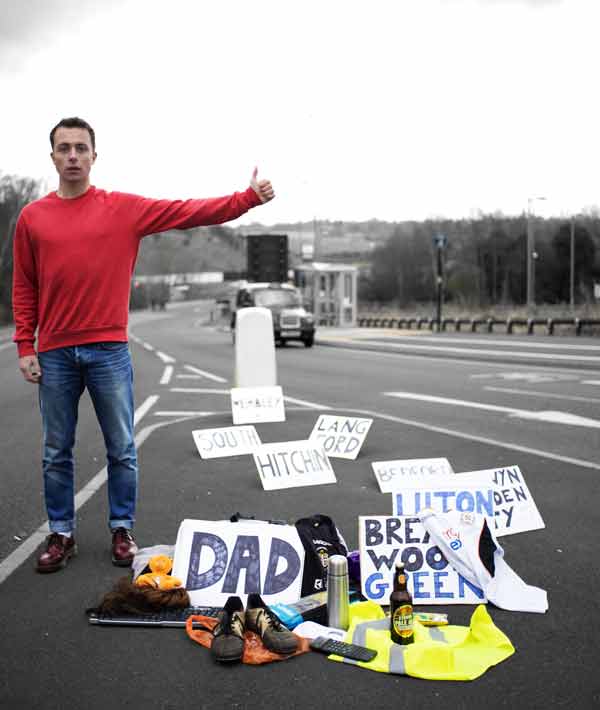
So in the summer of 2014 I set off with a video camera, a notebook full of addresses and phone numbers – old school friends of dad’s, football teammates, and the new landlords of pubs his parents used to run – and a whole load of hand-drawn hitchhiking signs covered in the names of obscure towns and villages in England’s midlands and south. I didn’t necessarily find what I was looking for.
I thought I was going to discover a series of events that explained away my dad’s taciturn nature and apparent emotional non-existence. But the questions I was asking became bigger and bigger until I was looking far harder at myself, and men in general, than I was about my dad. Why had I gone on this trip? Surely there were easier ways to find out about his past, and his present? When was the last time I actually spoke to him? Why haven’t I even told him I’m doing this thing? I think it’s precisely because I didn’t question my relationship with dad for the entirety of my youth – the fact I had such a ‘textbook’ childhood – that this show is important. I hope I have written something that speaks to the experience of many children, daughters as well as sons, and their relationships (or lack of) with their fathers. I hope it speaks to their partners too, or indeed anyone who has ever been or known a man. And I hope the show offers a quiet challenge to the accepted modes of behaviour that men feel they have to contain themselves within.
At its worst, the emotional narrowness historically afforded to men is responsible for so many of the world’s problems: we feel they have to respond to things with force rather than discussion; we are unable to have nuanced conversations about consent; we cannot admit we are wrong; we are stubborn and inflexible and full of pride; we abuse our power; we kill ourselves rather than ask for help. Of course this isn’t true of every man, but it absolutely remains the dominant social narrative. This show is my small contribution to a conversation that has finally found its way into the media spotlight, in the wake of #metoo, Trump, and all the other ways men are shit to people all the time. I want to ask how we can be better, to ourselves and to others. But don’t worry, there are jokes in there too. 'The Hitchhiker’s Guide To The Family' is ultimately my attempt to celebrate my dad, the relationship we had and – more importantly – the relationship we can have, and are starting to have. It’s about realising that you don’t know as much as you think you do when you’re 21. It’s about giving men permission to be full human beings. And playing as many '70s and '80s bangers as I can in an hour and ten minutes.
I’m excited to bring 'Hitchhiker’s' to the Adelaide Fringe because I’ve never performed it outside the UK before (I’m less excited about performing in 40 degree heat!). I hope the show has as much to say to Aussie audiences as it did to British ones. I suspect it isn’t just our dads who are bad at talking about their feelings, nor just British men who obsess over crappy lower-league sports teams like it’s a life and death situation. And I’m sure it’s not just me who likes ELO, Steely Dan, REM, and the Stones?”
– Ben Norris
By all accounts I had an unremarkable childhood, and I was very lucky in that respect – I had two living parents who were still together; I had a younger sister; I went to an adequate school; I was supported in my hobbies and passions (sports, music, and drama); and given permission – I felt – to be whoever I wanted to be. Throughout my childhood I was always far closer to my mum; she was the one I would approach with a problem or a question because, like most people, I think I had been conditioned to believe that mums were the ones who deal with emotional stuff and help you with matters of the heart, and dads are just there, shuffling around somewhere else in the house. The only emotion I’d ever seen dad express was anger, when Luton Town FC lost at home again or if you asked whether Mitchel could sleep over on a school night. Mum asks you how your piano exam/football match/cross country race went, dad just drives you there and back. At least that’s how it was in my house growing up. Women, we are taught, are emotionally complex beings, intimidatingly so, but they can’t doanything outside the home, and men are immensely practical, strong and useful, but they have the emotional bandwidth of a dogturd or a wasps’ nest – they just sit there, until you tread on them, and then they stink/really hurt you. And I accepted this.
But when I left home I realised I didn’t know anything about my dad, apart from superficial things like what football team he supports and how he butters his toast. I didn’t know anything about his childhood or his past, let alone his emotional life. And it was only when he wasn’t around every day, just being dad, that I stopped taking him for granted and started asking questions.
My dad was born in Brixton, in south London, and every time he moved house he moved north, loosely in line with the M1, the biggest motorway in the UK, until he reached Nottingham (about halfway up), which is where I was born and grew up. So I decided to start in Nottingham and hitchhike south down the M1, visiting all the places he lived as he was growing up, going backwards through his life in order to try and build a fuller picture of him. If I could get to know him better in the past, I thought, then perhaps I can know him better in the present.
So in the summer of 2014 I set off with a video camera, a notebook full of addresses and phone numbers – old school friends of dad’s, football teammates, and the new landlords of pubs his parents used to run – and a whole load of hand-drawn hitchhiking signs covered in the names of obscure towns and villages in England’s midlands and south. I didn’t necessarily find what I was looking for.
I thought I was going to discover a series of events that explained away my dad’s taciturn nature and apparent emotional non-existence. But the questions I was asking became bigger and bigger until I was looking far harder at myself, and men in general, than I was about my dad. Why had I gone on this trip? Surely there were easier ways to find out about his past, and his present? When was the last time I actually spoke to him? Why haven’t I even told him I’m doing this thing? I think it’s precisely because I didn’t question my relationship with dad for the entirety of my youth – the fact I had such a ‘textbook’ childhood – that this show is important. I hope I have written something that speaks to the experience of many children, daughters as well as sons, and their relationships (or lack of) with their fathers. I hope it speaks to their partners too, or indeed anyone who has ever been or known a man. And I hope the show offers a quiet challenge to the accepted modes of behaviour that men feel they have to contain themselves within.
At its worst, the emotional narrowness historically afforded to men is responsible for so many of the world’s problems: we feel they have to respond to things with force rather than discussion; we are unable to have nuanced conversations about consent; we cannot admit we are wrong; we are stubborn and inflexible and full of pride; we abuse our power; we kill ourselves rather than ask for help. Of course this isn’t true of every man, but it absolutely remains the dominant social narrative. This show is my small contribution to a conversation that has finally found its way into the media spotlight, in the wake of #metoo, Trump, and all the other ways men are shit to people all the time. I want to ask how we can be better, to ourselves and to others. But don’t worry, there are jokes in there too. 'The Hitchhiker’s Guide To The Family' is ultimately my attempt to celebrate my dad, the relationship we had and – more importantly – the relationship we can have, and are starting to have. It’s about realising that you don’t know as much as you think you do when you’re 21. It’s about giving men permission to be full human beings. And playing as many '70s and '80s bangers as I can in an hour and ten minutes.
I’m excited to bring 'Hitchhiker’s' to the Adelaide Fringe because I’ve never performed it outside the UK before (I’m less excited about performing in 40 degree heat!). I hope the show has as much to say to Aussie audiences as it did to British ones. I suspect it isn’t just our dads who are bad at talking about their feelings, nor just British men who obsess over crappy lower-league sports teams like it’s a life and death situation. And I’m sure it’s not just me who likes ELO, Steely Dan, REM, and the Stones?”
– Ben Norris